
Do I Need to Upgrade My Electrical Panel for an EV Charger?
The short answer
Most Colorado homes do not need a panel upgrade. A modern 200 amp service usually has room for a Level 2 charger. Older homes on 100 amp service often do, though load management can sometimes avoid it.
The only way to know is a load calculation, which takes twenty to forty five minutes and is free with our assessment.
Owning an electric vehicle is one of the better upgrades a Colorado household can make. But before scheduling an installation, one question decides how simple or expensive the project will be: does your electrical system have the capacity to support a Level 2 charger?
This guide covers what your panel does, how much power a charger actually draws, how an electrician calculates whether you have room, when an upgrade is genuinely needed, and what happens if your garage is detached, finished, or nowhere near the panel.
What your electrical panel does
Your panel, sometimes called the breaker box or service panel, routes power from the utility connection to everything in the house. Its rating, whether 100, 150, or 200 amps, sets a hard ceiling on how much the house can draw at once.
Most modern Colorado homes run a 200 amp service, which comfortably supports normal household demand plus a Level 2 charger. Older homes may still run 100 amp service or less. If your household already has electric heat, central air, a hot tub, or a second EV, headroom disappears quickly.
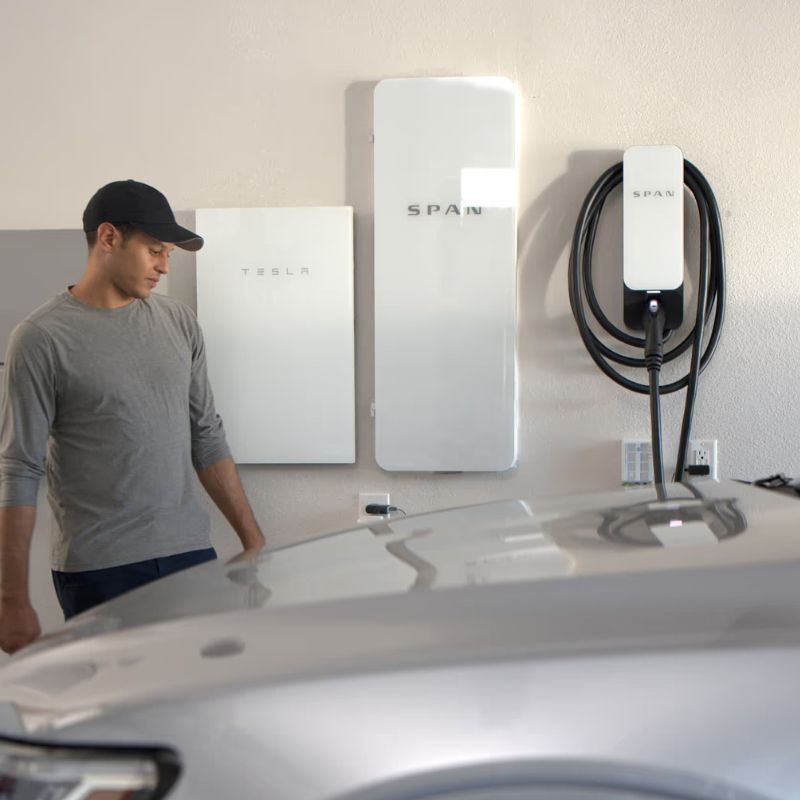
How much power does an EV charger actually need?
Level 1 charging plugs into a standard 120 volt outlet and adds three to five miles of range per hour. Level 2 runs on a dedicated 240 volt circuit and adds twenty five to forty. That second one is what needs planning.
| Charger rating | Circuit required | Typical use |
|---|---|---|
| 32 amps | 40 amp | Plenty for overnight charging, and the easiest to fit on a tight panel |
| 40 amps | 50 amp | The common middle ground across most brands |
| 48 amps | 60 amp | Fastest home charging. Needs the most headroom and heavier conductors |
The gap between charger rating and circuit size is the National Electrical Code at work. EV chargers are continuous loads, meaning they run three hours or more at a stretch, and a continuous load may not exceed 80 percent of a circuit’s rating. That rule is a common reason a panel that looks adequate turns out not to be.
How an electrician calculates your load
This is the heart of the process, and it is the clearest difference between an electrician who specialises in EV work and one who says they install everything.
| 01 |
Main service sizeColorado housing stock falls broadly into three groups. 100 amp service is common in older homes. 150 amp is typical of the 1980s through early 2000s. 200 amp is standard in modern construction. Homes on 100 amp service almost always need either an upgrade or load management to add EV charging. |
| 02 |
Total connected loadEvery significant load is counted: furnace or boiler, air conditioning or heat pump, electric water heater, range and oven, clothes dryer, hot tub, well pump, secondary refrigerators and freezers, plus the general lighting load the code requires. |
| 03 |
Demand factorsThe code permits demand factors, because a house never runs everything simultaneously. A proper calculation produces a realistic maximum, not a total of every breaker number on the panel. This step is why a panel that looks full on paper can still have genuine capacity. |
| 04 |
Remaining capacityThe question becomes simple. After everything else, is there room for another forty to sixty amp continuous load? If yes, the installation is straightforward. If no, you have options, and an upgrade is only one of them. |
Signs you may need a panel upgrade
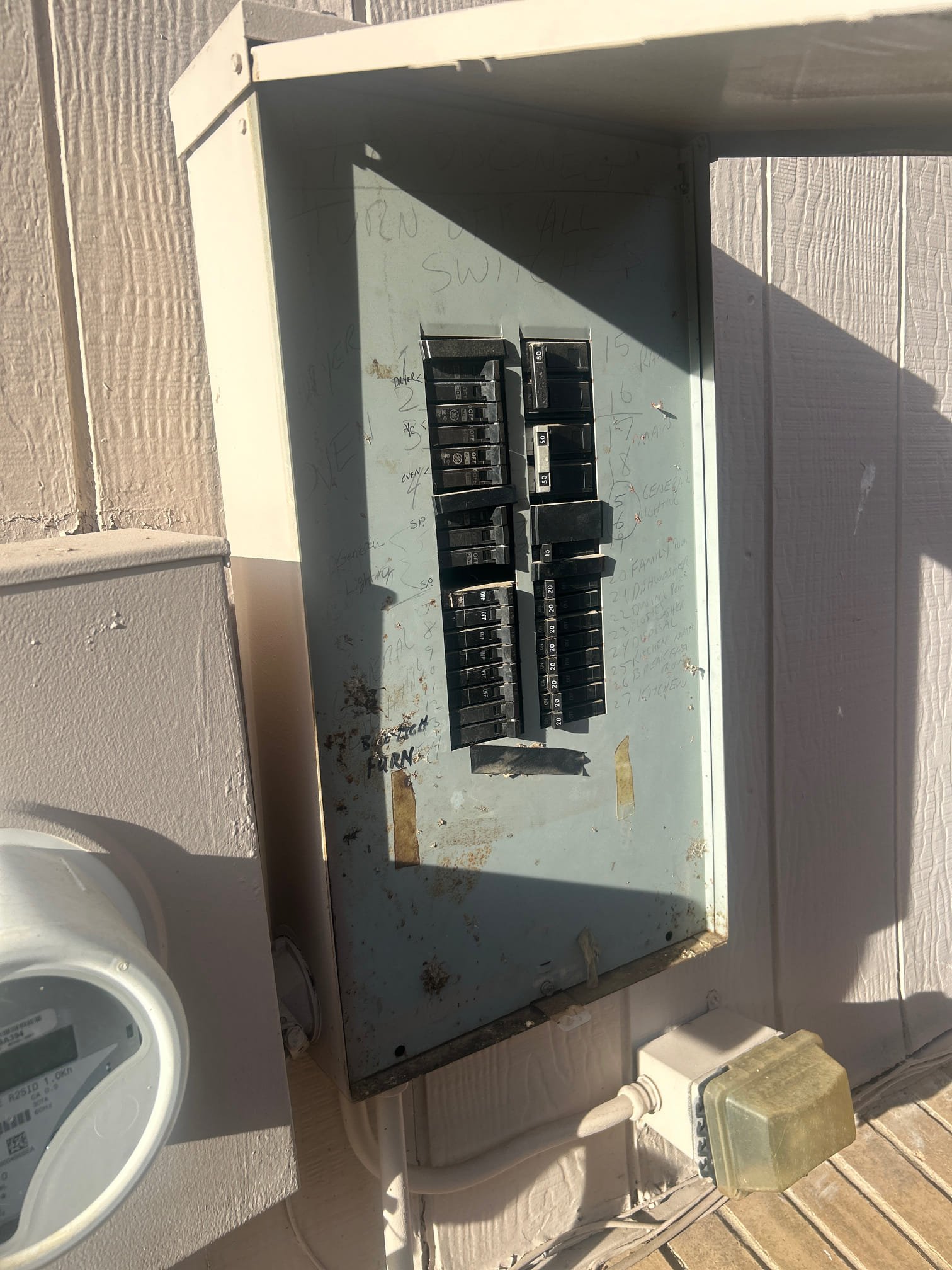
- Service rated below 200 amps, particularly 100 amp service in an all electric home.
- No free breaker slots. Without space for a two pole breaker, the 240 volt circuit has nowhere to land.
- Breakers tripping when several appliances run together.
- Lights dimming when the air conditioning or furnace starts.
- Warm breakers or hot spots on the panel face. This one warrants a call regardless of EV plans.
- A Federal Pacific or Zinsco panel. These are recognised fire risks and should be replaced rather than added to.
- A home built before the 1970s that has never had its service updated.
None of these are automatic disqualifiers except the last two. A load calculation still decides.
When you do not need an upgrade
Plenty of homes need nothing. Good candidates include newer houses on 200 amp service, homes with gas heat and few large electric loads, households choosing a 32 or 40 amp charger rather than 48, and homes where a smart charger can share capacity.
Choosing a lower amperage charger is the most underrated option here. Dropping from 48 amps to 40 costs a few miles of range per hour, which almost nobody notices overnight, and can be the difference between a simple circuit and a service upgrade.
Load management, the alternative to upgrading
If your panel is tight but not unsafe, a load management device may solve the problem outright. It monitors household demand and automatically reduces or pauses charging when the house approaches its limit, then resumes when demand falls. Installed correctly, it is fully code compliant.
It suits older homes with no spare capacity, condominiums and townhomes where a service upgrade is not permitted, households wanting to avoid the cost of an upgrade, and homes with heavy seasonal swings between summer cooling and winter heating. Several chargers now include the feature natively.
One honest limit. Load management is not a fix for a genuinely unsafe panel. If yours is a Federal Pacific or Zinsco, or shows heat damage, the answer is replacement rather than a smart charger layered over the top.
What a panel upgrade involves
A service upgrade replaces the panel, and often the meter socket and service entrance conductors, with a modern 200 amp assembly. The sequence is a load calculation, a permit, coordination with your utility for the disconnect and reconnect, the physical replacement, and a final inspection. Expect six to eight hours of work, usually scheduled on its own day, with a short power outage during the changeover.
The upside is that it is not only about the charger. An upgraded service creates room for a heat pump, air conditioning, a hot tub, or a second EV without repeating the exercise, and it removes an item that shows up on inspection reports when you sell.
What about my garage?
Panel capacity is the main question, but the second one is where the charger goes. The short answer is that most garages work, including older, detached, unfinished ones with no 240 volt outlet anywhere near them.
| Situation | What it usually means |
|---|---|
| Attached garage | The simplest case. A dedicated 240 volt circuit from the panel, often a short run |
| Detached garage | Underground conduit and trenching, sometimes a subpanel and larger feeder. Cost scales with distance, not difficulty |
| Finished garage | Conductors fished behind drywall or routed through an attic or crawl space, with surface conduit where that is cleaner. Minimal patching in most cases |
| Unfinished garage | Often quicker than a finished one. Open stud bays and joists mean direct access |
| Driveway or carport | Weather rated equipment, UV resistant conduit, and placement clear of downspouts and snowmelt |
| Long conduit run | Adds material and labor, and beyond roughly a hundred feet may require larger conductors to control voltage drop. Rarely a blocker |
Can I just use the dryer outlet?
Sometimes, and it is worth asking. Many garages already have a dryer outlet, an RV receptacle, a NEMA 14-50, or a workshop circuit. Reusing one can cut the cost of the job noticeably.
The catch is that an outlet looking right does not make it right. An electrician has to verify the circuit rating, the conductor size behind it, the breaker, the grounding, the condition of the receptacle, and whether the circuit is shared with anything else. A 14-50 wired for occasional dryer use is not automatically suitable for a continuous forty amp load for eight hours a night. Where it checks out, we use it. Where it does not, we say so.
What it costs
A straightforward charger installation runs about $500 to $1,600 including the equipment. Complex routing pushes labor toward $2,500. Trenching to a detached garage adds $500 to $2,000. A service upgrade adds $1,500 to $4,500 depending on the size of the service, the condition of the entrance, and what your utility requires.
Full breakdown is in our EV charger installation cost guide, and the schedule is covered in how long installation takes.
Rebates that apply to panel and wiring work
Worth knowing, because this is where the money now is. The federal 30C tax credit ended for equipment placed in service after June 30, 2026, and Colorado has no statewide charger tax credit. What remains is utility support, and several programmes specifically cover wiring and panel work rather than only the charger.
Xcel Energy offers up to $500 toward wiring and equipment, rising to $1,300 for income qualified customers. Several cooperatives offer a separate rebate for the panel upgrade itself. Conditions vary by provider and most require enrolling in an off peak rate. Details are in how to claim EV charger rebates in Colorado.
Frequently asked questions
Do I really need to upgrade my panel for an EV charger?Often not. Homes on a 200 amp service usually have room. Homes on 100 amp service frequently do need either an upgrade or load management. A load calculation is the only way to know, and it takes twenty to forty five minutes. |
How much does a panel upgrade cost in Colorado?A 200 amp service upgrade generally adds $1,500 to $4,500 to a project, depending on the age of the home, the condition of the service entrance, whether the meter socket needs replacing, and what your utility requires for the reconnect. |
Can I avoid a panel upgrade?Sometimes, by using a load management device or by choosing a lower amperage charger. Both are legitimate and code compliant where the panel is sound. Neither is appropriate if the panel itself is unsafe. |
Can my detached garage support an EV charger?Yes. Detached garages are among the most common installations we do. The work involves underground conduit and sometimes a subpanel, and the cost tracks the distance from the main panel rather than any particular difficulty. |
Can I use my existing dryer or RV outlet?Possibly. It depends on the circuit rating, conductor size, breaker, grounding, and whether the circuit serves anything else. An electrician must verify all of it, because an outlet suited to intermittent use is not automatically suited to a continuous overnight load. |
Will a bigger panel charge my car faster?Only indirectly. Charge rate is set by the charger, the circuit, and your vehicle’s onboard charger. What a larger service does is allow a higher amperage circuit in the first place, and deliver steady voltage under load rather than sagging when other appliances start. |
Electrical work beyond EV charging
EV charging is all we do. For whole home rewiring, standby generators, lighting, or emergency electrical service across the Front Range, our partner The Electricians covers the rest.